
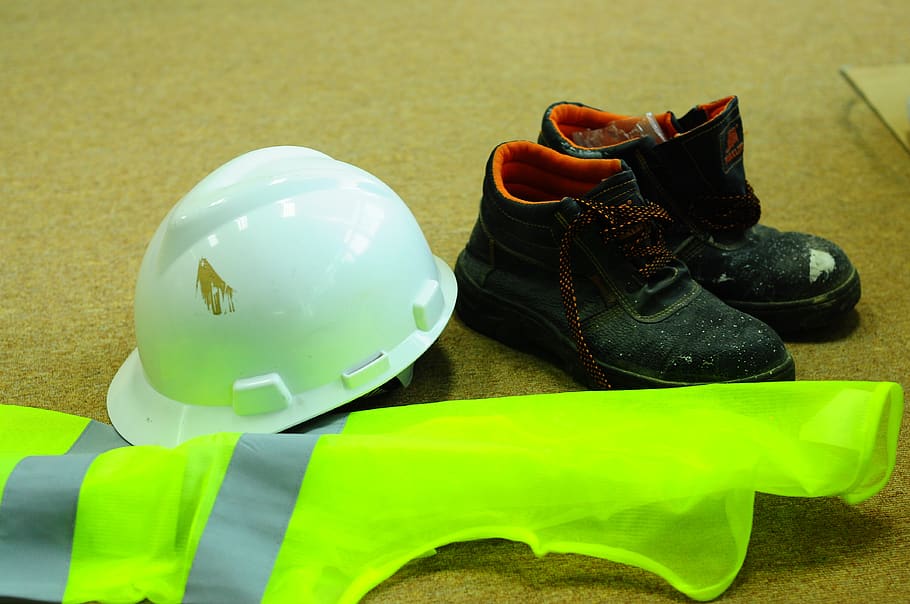
Construction industries in most developing nations are performing far lower than what is expected when it comes to issue of safety, the situation in Nigeria is also the same as per the provisions made by the National Building Code approved by the national executive council in the year 2006 which is yet to be enacted and enforced effectively till date.
Workers have a responsibility to protect their selves from physical harm hence why PPE is very important in a construction workplace.
CONSTRUCTION PPE CHECKLIST
- Head protection
Head protection is required on almost all construction sites. It is important for construction work to be organized to minimize all risks to workers, however, it is likely that hazards will remain, and everyone will be required to always wear safety helmets while on site.
To comply with the Personal Protective Equipment Regulations 1992, employers must provide all employees with, and ensure they wear, suitable head protection.
Employees should be provided with a safety helmet or hard hat for use at work; bump caps only protect from non-moving hazards and are not adequate protection for construction workers.
Acceptable head protection should:
- Be in good condition. Do not wear damaged PPE. If it’s damaged, it must be thrown away and replaced by the employer.
- Be a good fit for each individual and be worn properly.
- Not prevent someone from wearing hearing protection when required.
- Only be purchased from a reputable supplier.
- Ear Protection
Ear protection is needed to protect workers from noise hazards. Both the exposure duration and the sound level workers are submitted to can contribute to ear damage. Even if workers are only subjected for a short duration, very high-level sounds can still pose a hazard to the ears. Therefore, it is necessary for all workers to be provided with the correct type of hearing protection for the type of work they are undertaking.
The options available for ear protection are earplugs, earmuffs, and semi-insert/canal caps. Ear PPE must provide a suitable level of protection for the work being undertaken and must not compromise safety or communication. All workers must also be clear on how to wear their PPE correctly, to ensure maximum protection.
- Foot and Leg Protection
Construction workers are always be expected to wear protective footwear while on site.
The bones in the foot are easily damaged, with an injury to muscle or tendons potentially prohibiting normal foot movement for several months. Therefore, it is highly important to take precautions that minimize the risk of a foot injury. The ideal foot PPE encompasses steel toecaps, to protect from dropped objects, and steel midsole protection, to protect against puncture or penetration wounds from stepping on sharp objects.
The employer must provide a basic standard of footwear (or a suitable kit for individuals who cannot wear basic footwear for medical reasons) free of charge, on the condition that employees look after their equipment appropriately and make it last for a reasonable length of time.
What About Rigger Boots?
Rigger boots have seen a surge in popularity over recent years, likely because they are a cross between lace up boots and wellingtons and are simple to put on. But, due to their loose fit, rigger boots leave workers more susceptible to sprained or twisted ankles as workers are unable to stop their foot from twisting when walking on uneven ground. For this reason, some contractors refuse to allow rigger boots on site. This is a justifiable argument against rigger boots and workers are expected to understand the reasoning and comply with the contractor’s ruling.
However, when working with asbestos or cement, rigger boots might be the preferred type of foot protection. This is because boots without lace holes provide a greater deal of protection in this case as cement and asbestos are prevented from entering the PPE.
Can Workers Wear Shorts?
Whether workers are allowed to wear shorts on a construction site depends on the site’s policy. Clothing worn on construction sites must protect against hazards. Wearing shorts could leave the lower leg vulnerable to various injuries that could become infected, as well as weather conditions and trade specific hazards (such as overexposure to UV light when working with arc welders) If the site policy states that workers must not wear shorts to work, then everyone is expected to adhere to the ruling.
- Eye and Face Protection
It is important to wear eye and face protection when at risk of hazards involving chemical or metal splashes, dust, projectiles, gas, vapors, and radiation.
The types of eye protection available are:
- Safety spectacles.
- Goggles
- Face screens.
- Face shields.
- Visors
When selecting eye and face protection, it is important to ensure that it is task-suitable and that the correct fit is selected for each worker. If not, workers will still be vulnerable to risks.
- Lung Protection
Lung protection is commonly required when working on a construction site as workers often encounter hazards such as dust, gases, and vapors. When selecting lung PPE, it is important to ensure that the chosen piece of equipment fits the intended user properly. If incorrectly fitting respiratory PPE is selected, an adequate seal might not be formed, leaving workers susceptible to workplace hazards.
Examples of lung protection include:
- Filtering facepieces.
- Respirators
- Power-assisted respirators.
- Self-contained breathing apparatus.
- Fresh-air hose.
It is important to ensure that the right type of respirator filter is used for the specified hazard, as each filter is only suitable for a small range of substances. Additionally, filters only have a limited lifespan.
- Whole Body Protection
When working on a construction site, there might be occasions when workers are required to work with contaminated dust (such as asbestos) or may be at risk from chemical or metal splashes, spray from pressure leaks or spray guns, entanglement of their own clothing, impact or penetration. In these situations, the use of conventional or disposable overalls, boiler suits, aprons or chemical suits made from various materials, might be required to protect from workplace hazards.
WHERE CAN YOU FIND QUALITY PPE.
Green safety limited provides a wide range of quality PPE safety equipment’s that guarantees to keep you safe at all working times. Do not go into that construction site or hospital unprotected. take responsibility for your safety Today.
Order your PPE Today.
We are Green Safety Limited Creating a Finer Cleaner and Safer Environment for you.